Risks to the Russian Economy Are Increasing: Deutsche Welle
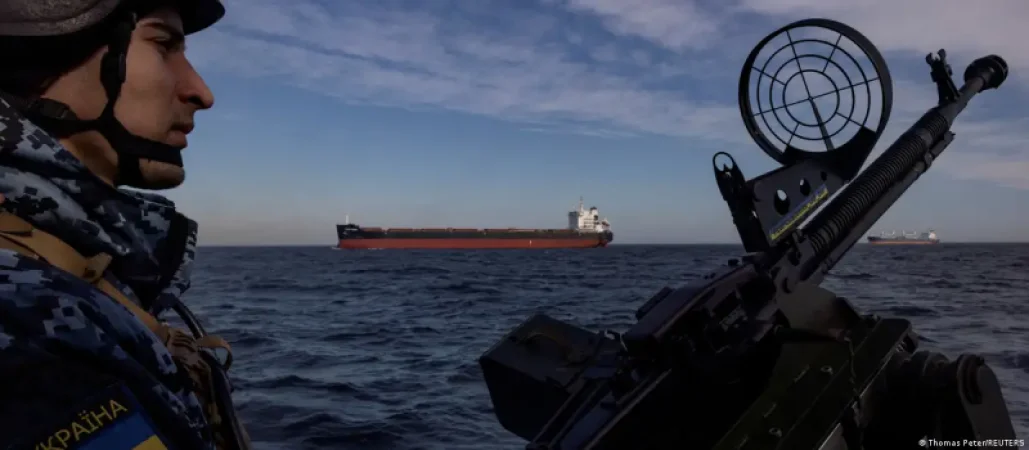
The intensification of Ukrainian drone attacks on Russia's export infrastructure in the Black Sea, in response to Russian strikes on Ukraine, has already created economic consequences. If the attacks continue, their impact could deepen, according to Deutsche Welle.
In 2014, explaining the reasons for Russia's annexation of Crimea, President Vladimir Putin stated that the entry of NATO forces into the region could fundamentally change the balance of power in the Black Sea area. NATO forces did not enter the region, but nevertheless, the balance of power changed after Russia launched a full-scale war against Ukraine. The Russian military navy no longer dominates the region as it once did, and the export of goods through the Black Sea has become more complicated due to Ukrainian drone attacks.
In recent weeks, the intensification of strikes on Novorossiysk, Russia's largest commercial port on the Black Sea, has caused significant disruptions in the transportation of oil and grain. Logistics routes can only be partially reconfigured. Experts interviewed by DW warn that if major attacks continue, the consequences for Russian exporters and the state budget could be significant.
Novorossiysk is the largest port in Russia by cargo turnover and one of the largest ports in Europe. It has been a key hub for Russia's foreign trade since the 19th century. Today, up to one third of Russian grain exports occur through Novorossiysk, due to its proximity to the country's main agricultural regions. Oil, metals, and containerized cargo are also exported from Novorossiysk to global markets.
The recent drone attacks by Ukrainian maritime and aerial forces have particularly severe impacts on grain shipments. According to Andrey Sizov, head of the analytical agency SovEcon, operations at the Novorossiysk flour mill and the Novorossiysk grain terminal were suspended on August 12, followed by the suspension of operations at the KSK terminal on August 13. The Taman terminal had already ceased operations at the end of July, and prior to that, the operations of shallow ports in the Azov Sea were paralyzed due to Ukrainian actions. The only remaining operational port among the offshore terminals is Tuapse, the smallest of them.
According to Sizov's estimates, as a result, Russian grain exports through the Azov-Black Sea basin have been almost completely blocked. In the case of oil supplies, the situation is not as drastic; exports have not completely stopped but disruptions are occurring regularly. According to Reuters, Russia's largest Black Sea oil terminal, Sheskharis, with a capacity of about 700,000 barrels per day, was forced to halt oil shipments on August 14, resuming operations only on August 16.
According to estimates by Argus, in the 2026-2027 season, Russia could export 45 million tons of wheat to the global market. Wheat is the country's main agricultural export product. However, if the blockage of the Azov-Black Sea basin continues for an extended period, exporting these volumes will be impossible, as approximately 90 percent of Russian grain supplies are usually sent via this route.
Andrey Sizov warns that the current situation could have serious consequences for many Russian producers, especially against the backdrop of their financial deterioration in recent years. With the disruption of exports, the surplus of grain remains in the domestic market, causing prices to decrease. Even if exports are restored later, it will not be possible to avoid losses entirely, as the maximum volumes of supplies are recorded in August. Compensating for the lost volumes in the autumn will be difficult, as terminals are already operating at maximum capacity during those months.
Escalation of military operations in the Azov-Black Sea region could also affect the global market. Russia is the world's largest wheat exporter, while Ukraine's wheat exports have also sharply declined. Since the second half of July, Russia has intensified its strikes on Ukrainian ports and the ships entering them.
Syaoyi Den, head of the agricultural commodity pricing direction at Argus, told DW that due to logistical disruptions, a significant portion of the rich wheat harvest in Ukraine and Russia has been cut off from the global market. Both countries are trying to use alternative routes, including Baltic Sea ports and Danube terminals, but these cannot fully replace traditional pathways.
In the first two weeks of August, oil exports through Novorossiysk decreased by 30 percent compared to the same period last year, according to data from the Center for Energy and Clean Air Research (CREA). This decline in cargo turnover was preceded by a drone attack on July 19 at the terminal of the Caspian Pipeline Consortium (CPC).
Supply volumes could decrease not only due to damage to infrastructure. Isaac Levin, an expert at CREA, told DW that some shipowners refuse to enter ports that are considered priority targets for drone attacks. Safe passage through the Black Sea is now not guaranteed for anyone.
According to Bloomberg, on August 17, a Greek tanker, which was reportedly carrying Russian oil, was attacked. Levin stated that if the current restrictions persist until the end of August, it will become more difficult for Russia simply to postpone supplies, hoping to compensate for lost volumes later. Some unexported oil could possibly be redirected through other routes, with the most realistic options being the Primorsk and Ust-Luga ports in the Baltic Sea. However, this would also increase transportation costs. The expert assessed that there is no complete replacement for Novorossiysk.
As with grain exports, the economic consequences in the oil sector will also depend on the duration and intensity of drone strikes, as well as Russia's ability to quickly restore damaged infrastructure. DW notes that the further development of the situation will also depend on the course of military operations in the Black Sea. On August 13, Ukraine's proposal to establish a ceasefire in the Black Sea was rejected by the Kremlin.
Նմանատիպ հոդվածներ
New Mobilization May Be Announced in Russia: Experts on Possible Timelines
According to The New York Times, some Western officials and analysts believe that Russian President Vladimir Putin may a...
180 Drones Destroyed in Moscow Region, 620 Drones Flew Towards the Area Overnight
From the evening of August 17 to 5:00 AM Moscow time on August 18, 620 unmanned aerial vehicles (UAVs) flew toward the M...

Drone Strikes Wildberries Warehouse Near Moscow
A drone has struck the Wildberries warehouse located in the "Atlant-Park" area of the Bogorodsk city region in Moscow Ob...

Six People Killed in Belgorod Region Shelling
Six civilians were killed and four others injured in a shelling in the village of Koloskovo, Valuysky District of Russia...
Ավելին Military բաժնից

Russia Inflicts Over $600 Billion in Damage to Ukraine's Infrastructure

We Will Correct This Man's Misconceptions Ourselves: Iran Responds to Trump's Statement

Trump Publishes Map of Hormuz Strait Labeled as 'New U.S. Territory'