‘The National Assembly is not a platform for discussing internal church matters’ – Supreme Spiritual Council on government statements
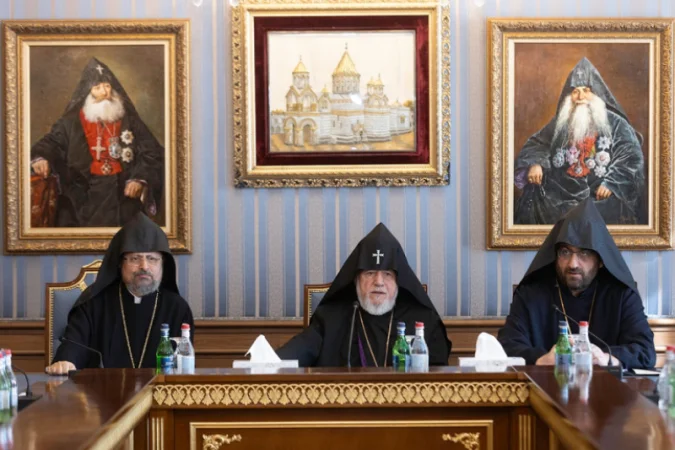
On August 26, at the Mother See of Holy Etchmiadzin, a meeting of the Supreme Spiritual Council, Armenian bishops, and diocesan leaders was held under the presidency of His Holiness Catholicos Garegin II. The agenda of the meeting included administrative, canonical, and disciplinary issues of the Church, questions concerning the Church's mission, as well as the situation in Church-state relations.
As a result of the discussions, the Supreme Spiritual Council issued a statement addressing the recent comments made in the National Assembly regarding the Armenian Apostolic Church and clergy. The Council noted with ‘deep sorrow’ its observations on the behavior of representatives of the ruling Civil Contract faction in the newly formed National Assembly, deeming it unacceptable.
According to the statement, in the face of the challenges confronting the country, the authorities, instead of fulfilling their duties, again target the Armenian Apostolic Church. The Supreme Spiritual Council assessed that such a policy could exacerbate existing tensions and create new divisions both in Armenia and in the Diaspora.
The statement mentioned that the authorities are attempting to discredit the Church and its clergymen by accusing the Armenian Apostolic Church of being a ‘foreign influence agent’ and operating as a ‘state within a state’.
The Council also addressed the Church’s position regarding Artsakh. According to the statement, praying for Artsakh and raising issues of the rights of the Artsakh Armenians, the preservation of Armenian spiritual and cultural heritage, and the release of Armenians held in Baku, leads to the Church being represented as a ‘party to the war’ and a ‘security threat’.
The Supreme Spiritual Council insists that accusations and criminal prosecutions against the Mother See, the Catholicos, and clergy are attempts to create grounds for interfering in internal church life and limiting the Church’s autonomy.
‘Condemning the ongoing actions, the Supreme Spiritual Council notes that there is an attempt to form an artificial agenda around the Armenian Church,’ reads the statement.
The Council emphasized that the government has no constitutional authority to make the reform of the Armenian Church part of its program or to impose demands and suggestions on clergymen at its discretion.
‘The National Assembly is not a competent platform for discussing internal church matters. The reform of the Armenian Church cannot be carried out under external pressure, threats, or any such arbitrariness,’ the Supreme Spiritual Council stated.
Among the political manifestations of the authorities towards the Church mentioned in the statement are also the removal of the subject ‘History of the Armenian Church’ from public schools, the dissolution of spiritual leadership in the Armed Forces, the suspension of spiritual services of clergy in penitentiary institutions, as well as, according to the Council, imposing additional taxes on the Church through unfounded penalties and fines.
The Supreme Spiritual Council concluded that the Armenian Apostolic Church will continue to be guided by the interests of Armenia and the global Armenian community, and will remain a defender of national identity and unity.
Նմանատիպ հոդվածներ
Complete Evacuation of Customs Personnel at Upper Lars
At the "Dariali" customs checkpoint in Upper Lars, located on the Georgia-Russia border, an automatic early warning syst...

VIDEO: How Many Children Are Currently Living in Armenian Orphanages and How is Adoption Conducted
Days ago, the story of a newborn girl found on Halabyan Street quickly captured the public's attention. More than 100 pe...
Discussion on the Armenian Apostolic Church in the National Assembly as Jehovah's Witnesses Hold Conference at Sports Complex
The large hall of the Karen Demirchyan Sports Complex has been rented by Jehovah's Witnesses to hold their regional conf...
Dollar Has Decreased Again: Today's Exchange Rates for Dollar, Euro, and Ruble
On August 25, the exchange rates for the US dollar, euro, Russian ruble, and British pound have decreased in Armenia. Th...
Ավելին Politics բաժնից
EAEU Adopts New Decision for Armenia Regarding Meat Imports
Canada is One of the Worst Countries in the World for Business, Says Trump
The Issue of Robert Kocharyan's Detention Will Be Reviewed at 20:30 - Judge's Name Revealed