Armenia Should Not Become the Second Ukraine: Suren Surenyants
If Nikol Pashinyan's envisioned European path suggests a repeat of Zelensky's journey—transforming the state into a stage for great power conflicts—then this story is not about European integration, but rather about a dangerous adventure. This is written by political scientist and leader of the Democratic Alternative party, Suren Surenyants.
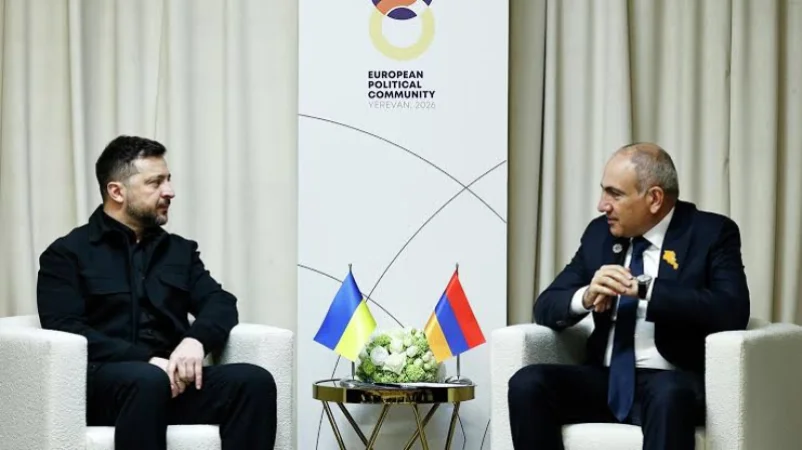
Armenia should not become the second Ukraine. “The Armenian people are confidently moving towards closer ties with the EU, and Ukraine is ready to provide assistance within its capabilities,” stated Ukrainian President Volodymyr Zelensky. This is one of those cases where we should hope that Zelensky will help Armenia as little as possible and that our country will not be seen as another address for spreading the Ukrainian experience.
The development of political and economic ties with the EU, access to European markets, investments, technological cooperation, and institutional reforms should and can be central to Armenia's foreign policy. The issue is the Ukrainian model.
The main danger of that model is the logic of geopolitical hard choices, under which the state becomes a target in the conflicts between great powers. In the case of Ukraine, the consequences have been tragic—war, immense human losses, devastated cities, millions of displaced persons, and a great dependency on external support. Armenia has no right to repeat that path.
Moreover, our initial conditions are incomparably more vulnerable. Armenia is a small country with limited demographic, economic, and military resources, under a complex security environment, and directly neighboring Turkey and Azerbaijan. In such conditions, transforming Armenia into a new platform for geopolitical confrontation is an extremely dangerous gamble for statehood.
Therefore, Armenia's real choice is not simply the binary option of “Russia or Europe.” The state's interests require deepening relations with the EU and the USA without dismantling relations with Russia, from which Armenia’s economy, energy, and security rely on crucial components.
Meanwhile, the dangers of polarization are becoming more visible in Nikol Pashinyan's foreign policy. Armenia is making a bid to advance on the path of European integration while simultaneously remaining a member of the EAEU and maintaining a significant economic dependency on Russia. Such a situation requires extremely careful and calculated politics.
In this context, Zelensky's support should not inspire us but awaken clarity. The tragic experience of Ukraine is not an example for Armenia to follow; rather, it is a warning about the severe consequences of a state becoming the epicenter of a major geopolitical conflict.
Discussions about Armenia's European prospects are valid and necessary. We should develop relations with Brussels, implement necessary reforms, attract investments and technologies, and expand Armenia’s foreign policy capabilities. But all of this should not turn Armenia into a forward base of Western elites' anti-Russian policies.
If Nikol Pashinyan's envisioned European path implies a repeat of Zelensky's journey—turning the state into a stage for great powers' conflicts—then it is a story not of European integration but of a dangerous adventure.
Նմանատիպ հոդվածներ
New Program Developed by the Government of Armenia: Key Directions Revealed
According to Article 151 of the Constitution of the Republic of Armenia, following the formation of the Government, the...
Two Complaints Filed by Gagik Tsarukyan Accepted by the Court
Gagik Tsarukyan's legal team has issued a statement: "We inform you that two complaints filed by Gagik Tsarukyan to the...
Charges Brought for the Sake of Accusation: Makinyan on the Charges Against Serzh Sargsyan
"The charges are so absurd that I find it difficult to comment on them. We are waiting to see how this case will logical...

Raids in Multiple Institutions Linked to Kocharyans: Investigation Committee Provides Details
The Investigation Committee has been conducting raids since early morning in several institutions associated with the Ko...
Ավելին Politics բաժնից
In the Church, let it be officially recorded that celibacy is removed: Ruben Rubinyan
Government Allocates 1.25 Billion Drams for Subvention Programs
Pashinyan Has Not Made Many Promises, But He Has Fulfilled Those Given to Aliyev: Kristin Vardanyan