How the Subsoil was Emptied and Some People's Pockets were Filled: "Zhamanak"
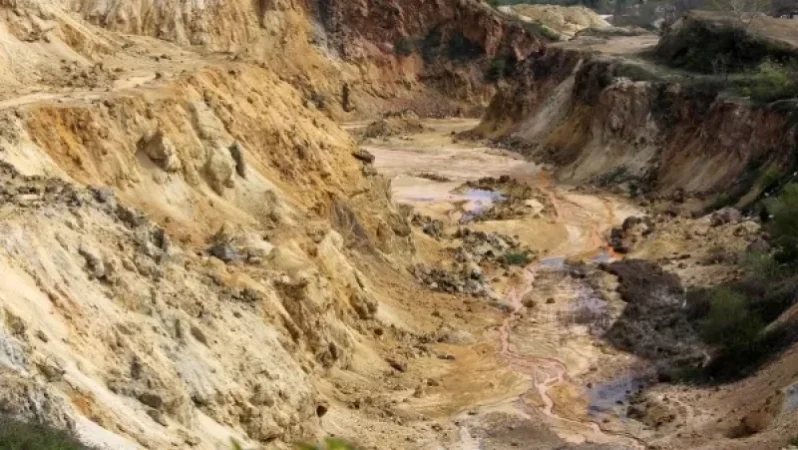
The extensive public and political discussions surrounding mining, which are emerging or, more accurately, still vaguely perceived in the context of the current issues regarding Amulsar, should have perhaps been a thing of the past for Armenia, a historical stage that would have led the Republic of Armenia to draw conceptual conclusions about the place, role, and significance of mining in its development process and to develop policies based on these conclusions.
Instead, Armenia finds itself in a situation where the subsoil has long been a direct and clear means of filling the pockets of the ruling system, nothing more. The public has been left with certain taxes that have, of course, played some role in the structure of the economy, but alongside this, public health and perhaps even lives have been compromised.
In the context of the realities of those years, it is hardly surprising that we now see extremities regarding the Amulsar issue. It is undoubtedly clear that extremities can never lead to deep, fundamental resolutions of such complex and multifaceted issues, if we do not say that they can complicate the situation even further. However, on the other hand, we are faced with a painfully objective picture of reality that should compel us to reflect not only on the specific issue at hand but also on the strategic prospects of mining, to do the work that has unfortunately and perhaps deliberately been neglected in the previous period since it would have interfered with addressing the enrichment of the ruling system.
In this sense, it is also symbolic, albeit with a rather sad tone, that the 29th anniversary of the adoption of the Declaration of Independence of Armenia coincides with a tense public situation. It is a sad symbol in the sense that nearly 30 years after the adoption of the Declaration of Independence, we see how many gaps have been left in these thirty years and what fundamental issues have been ignored, subordinated to group, immediate, and opportunistic interests, which have resulted in entering the fourth decade of our independence with deep problems that should have been addressed in the first three decades.
The current question is whether we can finally engage in these deep, fundamental discussions—stepping away from extremes and the current opportunism,” writes the newspaper.
Նմանատիպ հոդվածներ
Edward Madatyan's Son Has Passed Away
Edward Madatyan's son, Arman Madatyan, has passed away at the age of 34. He had been suffering from a severe heart condi...
I Confess: I Was Wrong. New Post by Naira Zohrabyan
The Chair of the Standing Committee on Human Rights and Public Affairs of the National Assembly of Armenia, Naira Zohrab...

NSS Responds to Facebook User's Post
The National Security Service (NSS) has responded to a post made by a Facebook user. On August 22 of this year, a Facebo...
“That product will only be suitable for the army; it’s not of the quality to be hot in all your points”: the future soldier’s father’s proposal by Bakur Melkonyan
Businessman Bakur Melkonyan wrote on his Facebook page: “Yesterday, one of my acquaintances asked me to meet someone who...
Ավելին Society բաժնից

Influencers to Be Fined $5000 for Political Advertising

15 Thousand Dram "Gift" Trap: Fake AMIO Bank Page Attempting to Steal Citizens' Money

Embezzlement of 87 Million Drams from Schools: Accountant, His Wife, and Directors Face Charges