The entire 'criminal underworld' is regarded as a unified system of criminal subculture, Prosecutor's Office

Within the framework of the Supreme Prosecutor's Office's appeal review, the Supreme Court issued a landmark ruling on August 28, 2026, concerning Article 324 of the Criminal Code, which pertains to the characteristics of participating in or involving oneself with a group carrying a criminal subculture. This decision involves a systemic analysis of offenses related to criminal subculture.
Specifically, interpreting the peculiarities of combating organized crime and criminal subculture in light of international convention provisions and precedents from the European Court of Human Rights, the Supreme Court established the key characteristics of a group carrying a criminal subculture, or 'criminal underworld.' The Court indicated that the grouping defined by law as the 'criminal underworld' is essentially synonymous with the term 'group carrying a criminal subculture,' and that, from a legislative perspective, they refer to the same phenomenon.
Therefore, within the framework of the aforementioned legal norm, it is not separate groups or organizations that should be considered as a group carrying a criminal subculture but rather the entire 'criminal underworld' as a unified system with its informal hierarchy, authorities, and influence, which operates according to the behavioral rules it has established and recognized. This is characterized by the 'resolution of problems' through violence, intimidation, and coercion. Moreover, the existence of the 'criminal underworld' is a well-known fact that does not need to be proven within the scope of criminal proceedings.
In other words, the prosecuting body is not required to substantiate and prove the existence of the 'criminal underworld' as a system carrying a criminal subculture in each specific case. Addressing the involvement in the pursuit of objectives pursued by a group carrying a criminal subculture, the Supreme Court noted that such involvement is manifested by the engagement of a person not affiliated with the group in any way that supports the objectives pursued by it.
In other words, such persons are outside the criminal hierarchy, do not belong to or participate in the grouping (the 'criminal underworld'), but merely have an ancillary involvement in realizing the group's goals. The Supreme Court emphasized that although sending requests to penal institutions is, in essence, permissible by law and cannot itself serve as a basis for determining participation or involvement in a group carrying a criminal subculture, it can nevertheless hold specific significance in assessing the aforementioned circumstances, taking into account the circle of individuals to whom the requests are sent, their frequency, as well as the nature of the relationship between them and the sender (for example, the sender is not a relative or close kin).
The Supreme Court noted that a person carrying a criminal subculture does not engage in the resolution of a specific issue as an individual but rather as someone carrying the morals of a criminal subculture, conditioning their actions within the framework of the ideology of this phenomenon and its pursued objectives, such actions being outside the scope of relations directed against property.
Նմանատիպ հոդվածներ

Ruble Depreciates: Exchange Rates as of August 27
According to Rate.am, as of August 27, the exchange rates are as follows: The average purchase price of the US dollar is...

The Ruble Devalues: Currency Exchange Rates as of August 25
According to Rate.am, as of August 25, the average purchase price of the US dollar is 362.5 AMD, while the selling price...

Tense Situation on Shinararner Street: Stalls and Garages Being Dismantled
Auroranews has received reports from stall owners claiming they have not been properly notified. They say they are not e...

Garegin II Prepares for a New Revolution: Pashinyan
Supreme Patriarch of All Armenians Garegin II, whom Prime Minister Nikol Pashinyan continues to refer to as Ktrich Nersi...
Ավելին Society բաժնից

Education Ministry Modifies Teachers' Certification System

CBA Announces New Exchange Rates for Dollar, Euro, Ruble, and Gold
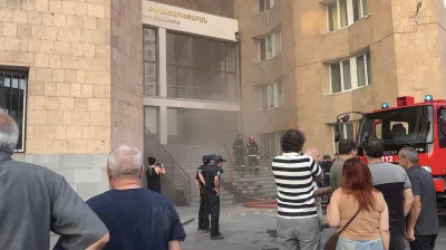
City Hall Thinks There Is No Need to Investigate the Fire at 1/3 Buzand Street