Publication of Transport Corridors and Railway Map Agreed in Moscow: Kommersant's Article
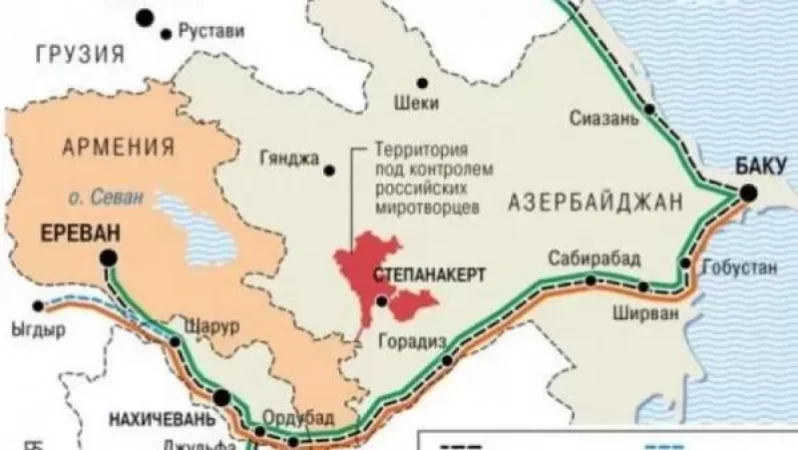
On January 11, the outcomes of the trilateral negotiations between the leaders of Russia, Armenia, and Azerbaijan held in Moscow received diametrically opposing evaluations in Baku and Yerevan. This was reported by Kommersant, which published a map of the transport corridors and railways agreed upon by Armenia, Russia, and Azerbaijan.
According to the source, the meeting was considered successful in Azerbaijan, as an agreement was reached on unblocking economic and transport connections in the region. In contrast, the opposition in Armenia accused Prime Minister Nikol Pashinyan of weakness and conceding positions, as the Armenian society views the return of prisoners as a primary issue, while economic matters were discussed during the negotiations.
The publication states that there are two main directions discussed during the negotiations. The first is that this corridor connects the main part of Azerbaijan to the exclave of Nakhchivan, which is supposed to pass through Armenia's Syunik province. The second is the option of a railway leading from Yerevan to Syunik province, passing through Nakhchivan. The source notes that both routes were actively used during the Soviet era but ceased to exist with the onset of the Nagorno-Karabakh conflict.
Kommersant highlights that the closure of these transport routes also affected Russia at the time. When transporting trains from Russia to Georgia became impossible due to the Georgian-Abkhaz conflict, Armenia lost its most reliable route to its main ally, while Russia lost its connection with Turkish railways.
The media outlet mentions that expanding economic ties with Iran could provide significant assistance to Armenia, which has not been possible until now, given that the two countries are connected only by a single mountainous road.
“Thus, the documents signed in Moscow should theoretically be beneficial for all three sides: Azerbaijan needs a route to Nakhchivan and Turkey, Russia to Turkey and Armenia, and Armenia to Russia and Iran. However, after the negotiations, de facto only Ilham Aliyev felt victorious, while Nikol Pashinyan focused in his speech not on achievements but on unresolved issues, primarily the lack of Baku's willingness to discuss the status of Nagorno-Karabakh and the fate of Armenian prisoners of war,” the article concludes.
Նմանատիպ հոդվածներ

The Failure of Negotiations Would Eventually Lead to War: Interview with David Tonoyan
In an interview with Mediamax, former Armenian Minister of Defense David Tonoyan discussed various issues surrounding th...
Armenians and Azerbaijanis Should Live Together in Artsakh Without Peacekeepers and Observers: Details from Erdogan-Putin Phone Call
Turkey will contribute to stability and peace in Artsakh. This was stated by Turkish President Recep Tayyip Erdogan duri...
Azerbaijanis Remain in Two-Storey House in Vorotan: Former Resident Not Allowed to Retrieve Belongings
In the Vorotan community of the Syunik region, a two-storey house that once provided jobs for residents has been taken o...
Ararat Mirzoyan Issues Statement
The Speaker of the National Assembly, Ararat Mirzoyan, has issued a statement, which in particular states: “In January 1...
Ավելին Politics բաժնից

Trump Demands Pentagon Explain Why US Arsenal Is Depleting

Zakharova Accuses Macron of Involvement in Ukrainian 'Terrorist Activities'

Former Executive Director of Multi Group Sedrak Arustamyan Detained for Two Months