Europe Pays Dearly for the Heat: €180 Billion Hit to the Economy

This year’s anomalous hot summer will cost the European Union economy approximately €180 billion, equivalent to about 1% of GDP. According to new analysis, this amount is comparable to the total economic growth the bloc was expected to achieve by 2026.
Based on a study by Triodos Bank, France could lose 1.4 percentage points of growth, leading to a contraction of 0.6% in its economy. In the Netherlands, a drop of 0.8 points will almost completely negate the expected expansion of the economy.
Experts indicate that the difficulties in working under extreme heat conditions will become a major brake on the economy. Their assessments suggest that productivity losses could take away approximately 0.6% from the EU's GDP. The region's agricultural production may decrease by 3-7%. For instance, due to a lack of rainfall, Austria's agriculture sector has already suffered around €1 billion in damages due to drought.
Low water levels in the Danube and Rhine rivers have limited the operation of Hungary's Paks Nuclear Power Plant, while Romania has been forced to blast rocks to redirect water toward its reactor and has also restricted the loading capacity of river vessels.
During the record heatwave that lasted from mid-June to early July, at least 14,000 heat-related deaths were recorded across six of the most severely affected European countries. The summer is not over yet, with France and the United Kingdom preparing for the fifth heatwave of the season this week, with temperatures approaching 40°C in southeastern France and up to 36°C in the UK.
Triodos Bank analysts urge that this summer should not be viewed as a one-time anomaly, warning that extreme heat may become a “structural phenomenon.” Experts believe that governments could mitigate the damage by investing in irrigation, building insulation, air conditioning systems, and adjusting work schedules.
Նմանատիպ հոդվածներ

Tomato Yields in Armenia Expected to Reach Up to 41 Tons per Hectare
According to specialized agrometeorological calculations and an analysis of observed weather conditions, it is forecaste...
Armenia Allocated Additional Quota for Importing 5,000 Electric Cars Duty-Free
According to a decision by the Eurasian Economic Council, Armenia has been allocated an additional quota of 5,000 electr...
Activity of the Bread Production Workshop at 'Ziranche' Supermarket Suspended
The food safety inspection body has suspended the activity of the bread and pastry production workshop at the 'Ziranche'...

I Don't Care Who the Director of Haypost Is, Explain the Spending of Billions: Ioannissyan
We are a very interesting society. No one cares that Haypost operates with billions of drams in losses, and that money c...
Ավելին Economy բաժնից
In the Coming Days, Armenia Will Sell Goods to Azerbaijan
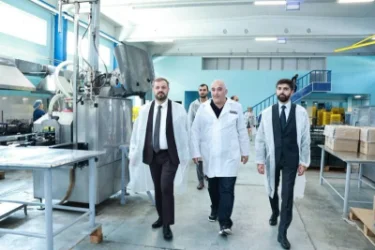
Papoyan Visits Ararat Food Factory to Monitor Harvesting

Armenia May Lose Duty-Free Access to Russian Market: Which Sectors Are at Risk