Severe Magnetic Storms Threaten Earth
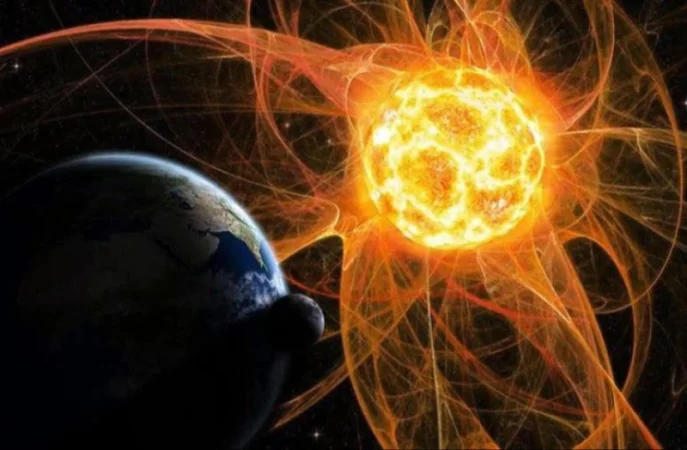
Scientists from the Solar Astronomy Laboratory of the Institute of Space Research of the National Academy of Sciences of the Republic of Armenia and the Institute of Solar-Terrestrial Physics warn about high magnetic activity resulting from a large coronal hole located in the southern hemisphere of the Sun. This phenomenon, which began to affect Earth on May 17, 2025, continues to influence space weather and the planet’s magnetic field.
A coronal hole is a region of the Sun’s corona where plasma density and temperature are low, and the magnetic field is open, allowing solar plasma to flow into space in the form of solar wind. On May 18, Earth was fully immersed in this plasma flow, which exhibits extreme characteristics, creating conditions for magnetic storms.
Characteristics of the Solar Wind
According to scientists, solar wind speed near Earth reaches 700–800 km/s, nearly double the typical figures. The temperature of the surrounding gas has risen to half a million degrees Celsius and above, which is five times the norm. Such conditions significantly increase the likelihood of magnetic disturbances.
Magnetic indices reflecting the state of the magnetic field fluctuate between yellow and green zones since the morning of May 18, indicating an unstable situation. Scientists note that the probability of magnetic storms in the coming days stands at 30–40%.
The Impact of Magnetic Storms on Health
Magnetic storms can have a noticeable effect on weather-sensitive individuals. Physician-therapist Lyudmila Lapan explains that individuals with vascular diseases, as well as those who have experienced strokes or heart attacks, are particularly vulnerable. Possible symptoms include:
- Headaches;
- Weakness and increased fatigue;
- Elevated blood pressure;
- Vascular spasms.
To minimize negative effects during storms, it is recommended to:
- Take medications prescribed by a doctor;
- Eat light and healthy foods;
- Avoid stressors and physical strain.
How Coronal Holes Affect Earth
Unlike solar flares, coronal holes do not create extreme magnetic storms of G5 level, as seen in May 2024, but can induce storms of moderate intensity (G1–G3 levels). Due to the complex structure of the hole, sudden fluctuations in solar wind speed disrupt the stability of the Earth's magnetic field, leading to magnetic disturbances.
Scientists emphasize that the current solar cycle, which peaked in 2024, remains active. Although the peak of activity has passed, magnetic storms will occur periodically in 2025, especially during periods when Earth is within the influence zone of coronal holes.
Forecast and Recommendations
According to predictions from the Solar Astronomy Laboratory, Earth will remain under the influence of the coronal hole at least until the end of the current week. While exact dates and intensities of storms are still hard to predict, scientists recommend monitoring updates on the Kp magnetic index and predictions of auroras, which may be visible even at mid-latitudes. For weather-sensitive individuals, it is important to prepare in advance for possible storms by following doctors' recommendations. Additionally, magnetic disturbances may temporarily affect satellite navigation and radio communications, which should be considered by operators of technical systems.
Նմանատիպ հոդվածներ

Drop in Currency Market: Today's Exchange Rates
The exchange rates for May 19, as presented by Rate.am, are as follows: The maximum purchase price for the US dollar is...

Ruble Strengthens: Today's Exchange Rates
According to Rate.am, the exchange rates for May 20 are as follows: The maximum purchase value of the US dollar is set a...

Power Outage in Yerevan and Several Regions: Addresses
The Electricity Networks of Armenia reports that on May 19, power supply will be temporarily suspended to carry out sche...

Power Outages in Yerevan and Several Regions
The Armenian Electric Networks Company has announced that on May 20, planned maintenance work will temporarily interrupt...
Ավելին Society բաժնից

Russian Orthodox Church Supports Armenian Apostolic Church
Heavy Rains in Georgia Damage Houses, Roads, and Bridges

Armenia Surpasses Azerbaijan in Prosperity Index