Cultural Genocide as Victory: An Alarm Raised About the Destruction of the Mother Cathedral in Stepanakert
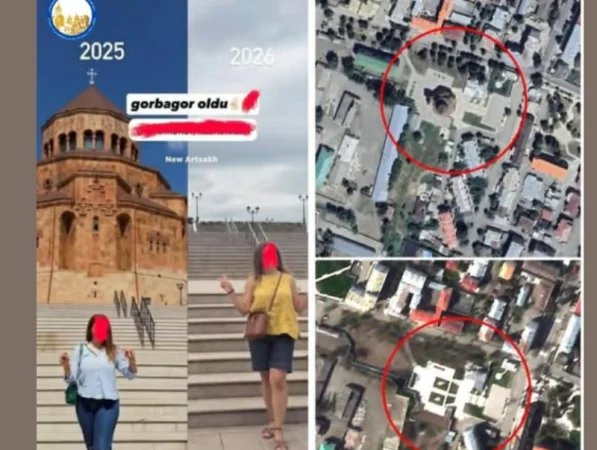
The Ombudsman for Cultural Heritage of Artsakh, and Vice President of the "National" Historical and Cultural NGO, Hovik Avanesov, raises an alarm: "Recently, a photo has circulated on Azerbaijani social media taken in the vicinity of the Holy Mother of God Cathedral in Stepanakert. It is particularly painful to note that the Azerbaijani girl who published the photo was present at the same location in 2025 when the cathedral was still standing. Thus, the new photo not only documents the destruction that has occurred but also clearly demonstrates the attitude that has developed towards Armenian cultural and spiritual heritage.
Satellite monitoring data confirms that the Mother Cathedral was destroyed between March 3 and April 2, 2026. In recent months, repeated alarms regarding the destruction of the cathedral have been raised by the Office of the Ombudsman for Cultural Heritage of Artsakh, as well as by other organizations and experts in the field of cultural heritage protection and satellite monitoring.
However, one of the most characteristic and simultaneously painful aspects of this story is the caption attached to the photograph: "gorbagor oldu," meaning "it has disappeared," "it has been destroyed." The destruction of the Armenian church is presented not as a cause for pain or concern, but as a source of pride and satisfaction.
This phenomenon cannot be viewed as the behavior of a single individual or user; it is a manifestation of a deeper and systemic issue. When the destruction of a church is accompanied in the public sphere by expressions of joy and pride, it indicates that the formation of hostility towards Armenophobia and Armenian cultural heritage has a systemic nature in Azerbaijan.
The actions directed against the Armenian cultural heritage of Artsakh are long past being merely a question of the fate of individual monuments. It refers to a systematic policy of erasing the Armenian footprint, wherein churches, monasteries, cemeteries, khachkars, monuments, entire settlements, historical neighborhoods, and other cultural objects are either destroyed or subjected to alterations and reinterpretations aimed at negating their Armenian identity.
The destruction of the Mother Cathedral is particularly symbolic, occurring under conditions where the international community, international organizations, and cultural heritage protection entities are aware of the threats facing the Armenian heritage of Artsakh. Over the years, documents, professional reports, photographs, and satellite evidence have been published, yet practical and preventative measures often do not follow these attestations.
The current response of international bodies is evidently disproportionate to the scale of the threat. Each new destruction, accompanied by statements, concerns, and calls for action, cannot substitute for real actions; if the international community limits itself to merely documenting the destruction that has already occurred, it is not a defense of heritage, but a retrospective registration of the fact of destruction.
It is also unacceptable that professional bodies must reveal the destruction of monuments through satellite images, while competent international authorities are unable to ensure ongoing monitoring, independent expert evaluations, fact-finding missions, and effective mechanisms of accountability.
To save the cultural heritage of Artsakh, what is needed is not yet another procedural statement, but concrete measures: the introduction of international monitoring mechanisms, the involvement of independent experts, the systematic collection and publication of satellite data, legal documentation of each destruction, the identification of those responsible, and the application of mechanisms of international legal and political accountability.
The destruction of the Holy Mother of God Cathedral in Stepanakert should serve as another serious warning to the international community. If it is possible today to destroy an Armenian church and present that act as a "victory"—moreover, to take pride in it—this is not a new phenomenon. It follows the same logic that Azerbaijan's authorities used to glorify Ramil Safarov, who murdered sleeping Armenian officer Gurgen Margaryan, and similarly handled the beheading of Karabakh citizen Karam Sloyan.
The continuity of this logic implies that tomorrow another monument of the Armenian heritage in Artsakh could be under threat. Cultural genocide begins precisely at the moment when the destruction of a monument is no longer perceived as a crime and is transformed into a symbol of victory. Moreover, international inaction, regardless of the political or other reasons provided, effectively creates an environment of impunity.
The destruction of the Mother Cathedral in Stepanakert should not only be documented but also become a matter of the international legal and political agenda. Silence, delayed responses, and vague statements are no longer sufficient. Immediate, systematic, and measurable actions are necessary to save the Armenian cultural heritage, which represents a common human value, while the preserved monuments can still be saved."
Նմանատիպ հոդվածներ
We Have Taken a Blank Sheet and Started Writing the Text of a New Constitution: Arusyak Julhakyan
No part of the Constitution text has been removed because we are writing a new Constitution. We haven’t taken the Consti...
Law Enforcement Raids Narek Karapetyan's Residence
This morning, law enforcement agencies entered the residence of Narek Karapetyan and are conducting searches, reported "...
Armenian Government to Introduce New Economic Reforms
The Armenian Government is set to announce a series of economic reforms aimed at improving the country's financial stabi...
Police Officer Escorting Haik Konjoryan's Brother Dismissed
The police officer who accompanied Haik Konjoryan's brother, Avet Konjoryan, has been dismissed from his position. This...
Ավելին Politics բաժնից
We Cannot Accept a Constitution Imposed by Azerbaijan: Narek Karapetyan
“Armenia Should Have Multiple Partners” – Narek Karapetyan on EU Relations
Armenia Should Deepen Cooperation with the EU, Says Tigran Abrahamyan